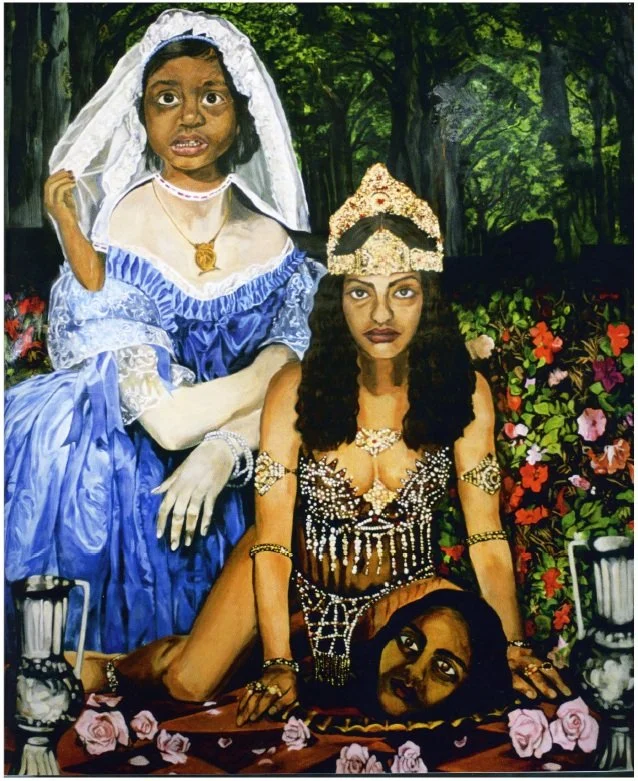
Interviewed by Heidi Howard for in Precog Magazine, Issue 8, Summer 2026
I first discovered Chitra Ganesh’s work as a graduate student at Columbia University in 2012. I was excited by how feminism and drawing were active threads illuminating materials from prints to paintings to wall paintings to installations to the moving digital screen. Her work connected things that made my heart beat, from ancient floral symbols to shaking fluorescent subway lights. I requested a studio visit with Chitra. Our conversation immediately brought magnificent new energy to my life because of Chitra’s intense intelligence, vision, and determination to make art deeply invested in the culture she wants to see—rooted from her ancestors in India to new global futures sprouting from the chaos of New York City. It seems appropriate to interview Chitra for the theme of Ouroboros, totality and integration, on the occasion of the publication of her first comprehensive monograph. This hardcover, 246 page book published by Distanz includes essays by Salsha Grayson, Tausif Noor, Natasha Bissonauth, Gayatri Gopinath, Swati Shah, Esenia Soboleva, and an interview with Erica Cardwell.
HH: In your interview with Erica Cardwell you said you “did not want a monograph of essays only by famous senior curators from the most resourced institutions.” I wanted this book to have a scaffolding of relationships and interconnection.” Can you talk about how community-building is integral to your artistic practice?
CG: Community and networks of friendship have been vital to nurturing my practice, grounding me, and provided an ethical compass that has been so important in navigating and making space for ourselves in the art world. For example, having friends and networks who can give you feedback on your work that is difficult to hear, but is so necessary to making the work better, is a game changer. This dialogue requires a certain level of trust and vulnerability that comes from friendships built around shared ethics and models for success that are value-rather than achievement-oriented. A large segment of our professional world that embodies the ethos of end-stage capitalism, market oriented, money comes first, competition results from perceived scarcity, can be lonely and discouraging. Friendship and community have been a life support.
HH: Do you think growing up in NYC with its many diasporas of affinity influenced the way that you think about community?
CG: Growing up amongst NYC’s thriving multiplicities has shaped my understanding of community in so many ways. My parents came to Brooklyn from Calcutta in 1972 on a green card lottery, on the heels of the first big wave of migration from South Asia when borders opened in 1965. There was a long period before that, starting with the Chinese Exclusion Act in 1882, which became the Asian Exclusion Act in 1907, of making immigration for most people of Asian origin illegal, if not impossible. I bring this up because it helps contextualize how relatively few immigrants from India there were at the time I was born. People like my parents who had grown up in huge families with seven to nine siblings and countless extended family members, suddenly found themselves alone. Both extroverts and city people, they built their networks of communities in every way they could, and in a way that could only happen in a city like New York. They met the folks who became their lifelong friends on the subway, doctor’s office, apartment building, supermarket, and on the street. This supermix, and an expression of an energy and ethos unique to the 1970s and 80s in NYC. I imagine this is something we share, having both grown up in part in Queens having friends of multiple nationalities, from diasporas both known and unknown. My friends in elementary school were of Egyptian, Panamanian, Ashkenazi Jewish, Pakistani, Sri Lankan, Trinidadian, Sicilian, Cuban, Puerto Rican, Indian, and African American descent. These diasporic threads of connection and intimacy became critical to how I approached building community in the late 1990s onwards, whether it was as a young woman of color in a predominantly white art world, or as a queer college student seeking my own BIPOC/desi communities.
HH: I want to talk about a work you made when I was 13: Covid Tears, 2020. I was so struck by this piece, sewn and painted on brown paper. It reminded me of my childhood in NYC, how if you were feeling panicked, they advised breathing into a paper bag. The paper brought back memories of kids doing that at lunch. It also recalled the feeling of wearing a paper mask. I believe I was wearing one when I first encountered the work in person. There is a cracked mirror over the main figure’s eye that she seems to be peering out of reminded me of this fractured digital space we were all looking into during covid, especially in NYC. For a while it seemed risky to even pass through a staircase to get outside. Also, I am reminded of grabbing accessible art supplies, brown paper, thread, hoop earrings. Can you talk more about the symbols in this piece and how you choose the many materials you work with?
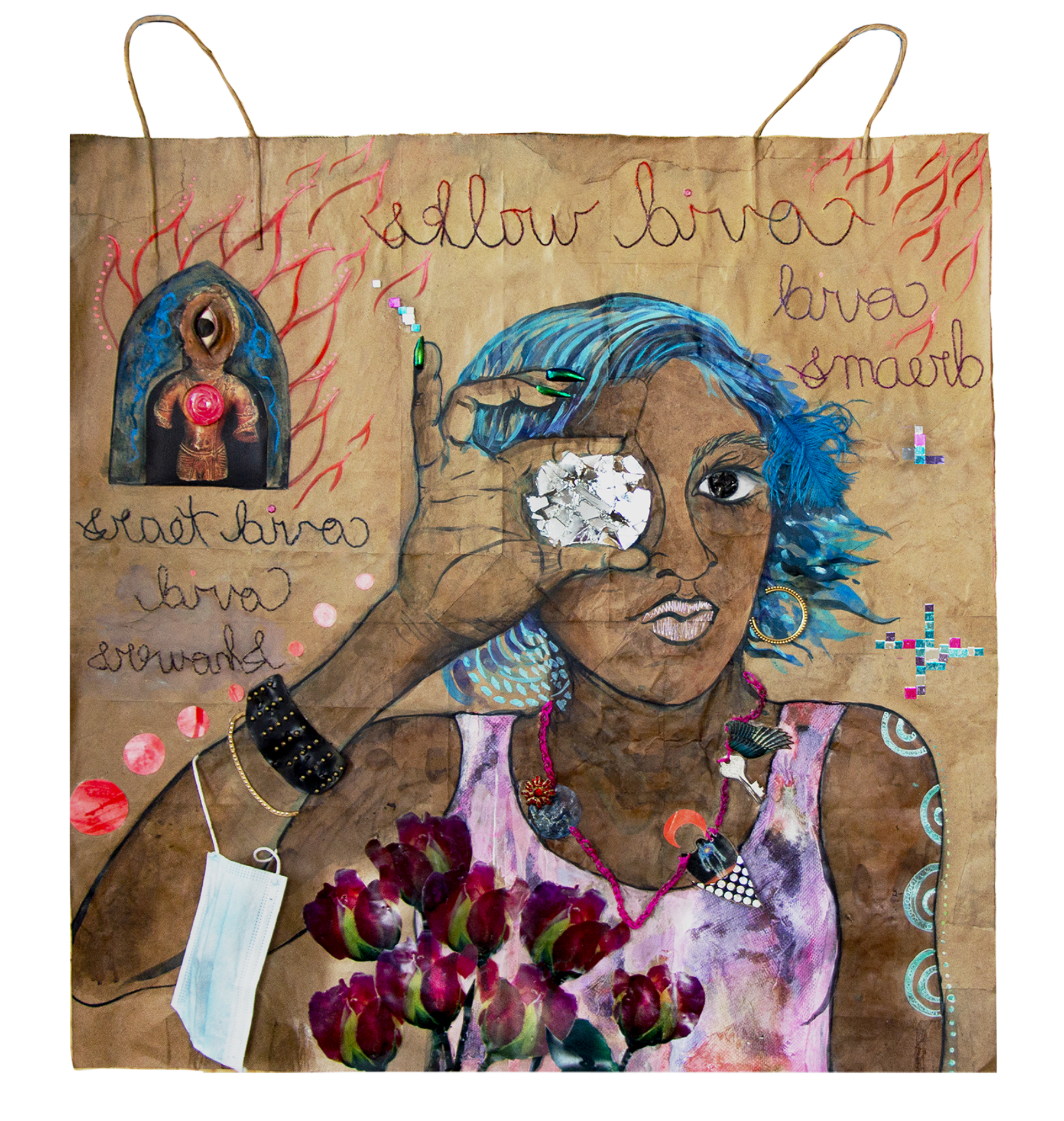
Chitra Ganesh, Covid tears, 2020, Mixed media on paper (bags) including glass, mirrors, embroidery, textiles, assorted trimmings, feathers, plastic, chalk, ink pastel, graphite, gouache, rubber, watercolor, and pen, 29 3/4 × 30 inches (75.6 × 76.2 cm), Courtesy of the artist, Gallery Wendi Norris, and Hales Gallery.
CG: Thank you for bringing up this piece. During the lockdown, I was struck by the massive quantities of brown paper and cardboard flowing in and out of our apartment building—the relentlessness of this wasteful and unnecessary packaging somehow came to mark this period of social isolation. In the ritual act of folding and organizing these reams and remnants of paper to recycle, that was quite a beautiful material, I began sewing these together or adhering layers with bookbinding glue, and the paper began to feel like a skin of sorts. I work with everyday materials partly because they are conduits for our embodied, everyday experience, such as grabbing a piece of cardboard and scrawling a protest slogan on it with a Sharpie—an image that predominates in my memory of the summer of George Floyd protests. There was an urgency, an elemental quality to the way in which the atria was used that I found refreshing, a direct expression of our times, and also connected to a long-held interest in integrating everyday objects into my visual language as a way to give the viewer multiple points of entry into the work. For example, perhaps your eye catches a familiar object being repurposed in an uncanny way, as much as it moves along the contours of a line. There are many objects in that work that we found on the street, collected during long solitary walks. I took around the neighborhood that spring and summer.
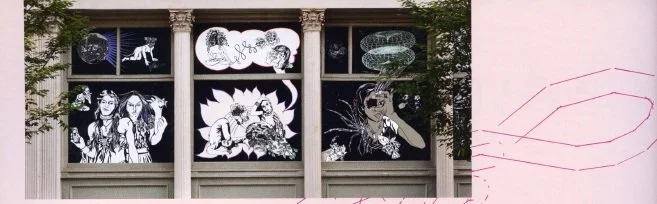
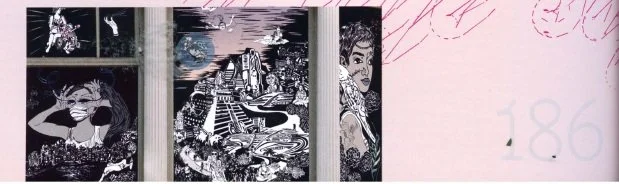
HH: I loved seeing your project “A city will share her secrets if you know how to ask” on the windows of the Leslie Lohman Museum. The white outlines of figures and buildings integrated so well into the historic tall-windowed architecture of lower Manhattan. I photographed the windows next to the white writing on the street signs. It was great to see your drawing feed-back into the city’s writing. It also seemed like an art installation made to be encountered on a long walk. Is that part of how you thought about it? I noticed old pre-smart phones were part of the work. They made me nostalgic for wandering without an easy update map.
CG: I’m so glad to hear that the encounter with the work resonated with you. My initial thought around the graphic visual language for this piece is that it would provide a formal contrast and visual respite from what had prior to the pandemic been a neighborhood where much of the public visual messaging was related to corporate advertisement, branding and fashion.
In this way, the hand-drawn black and white imagery was a stark counterpoint to the high-definition, super saturated, photo-based language, frequently featuring individual large-scale sized figures, that was characteristic of those billboards. This language was developed in conjunction with a large suite of linoleum prints I made called Sultana’s Dream, inspired by a Bengali feminist sci-fi novella written by Rokeya Sakhawat Hossain in 1905. In Sultana’s Dream and my QUEERPOWER façade commission for the Leslie Lohman Museum, the graphic sensibility was associated with rendering a utopic imaginary, as well as the political resonance of print culture as seen in Emory Douglass and Kathe Kollwitz.
“A city will share her secrets if you know how to ask” was very much inspired by my endless fascination with New York City and its five boroughs. Born in Brooklyn, having lived in Brooklyn, Queens, and Manhattan for virtually my whole life, I love how the city is not only capacious enough to hold the diasporic multiplicity we were speaking about earlier, but also how these polymorphous communities intersect with queerness. My own connection to cultivating queer culture was very much a result of spending time in public spaces—for example making out in parks, under bridges, and on subway cars; or the experiences I had entering subcultural spaces of my adolescence such as CBGB, St. Mark’s Comics, Limelight, Antique Boutique, the Knitting Factory, and more. What I love about the city is that it is home to both the iconic and the anonymous, and such a vast cross-section of every type imaginable including class. I see this raucous plurality in your work as well, as a lens through which you approach portraiture, color, and the layering of marks.
With each passing year, the city has become more stratified by gentrification and corporate restructuring. The ensuing real estate crisis in New York has made living here unattainable for many of the kinds of people we grew up with. These changes have also fundamentally altered my own sense of the city. I remember wandering through empty neighborhoods at night, a time when the meatpacking district was primarily a space for sex parties and sex work, when the piers saw a flourishing of young queer life, and DUMBO was completely undeveloped. Now the city is heavily surveilled and policed, and corporate culture and presence marks the city in a more ubiquitous way. The city’s reflection on my work becomes embedded within the mural, and vice versa. This bleeding in and out reflects the way in which the city’s endless subjective realities seep and spill over into one another, breaking down certain boundaries and social codes that are more easily enforced in places where people have no choice but to drive from one place to another, or live in gated communities. I loved hearing about peoples’ encounters with the mural. Some of my friends who moved downtown temporarily because they got a great deal during the pandemic spent time with the windows during their pandemic walks, or would be happy to glance by on their bikes. In that way public art is like a song you hear a million times, and differently depending upon your mood or the weather.